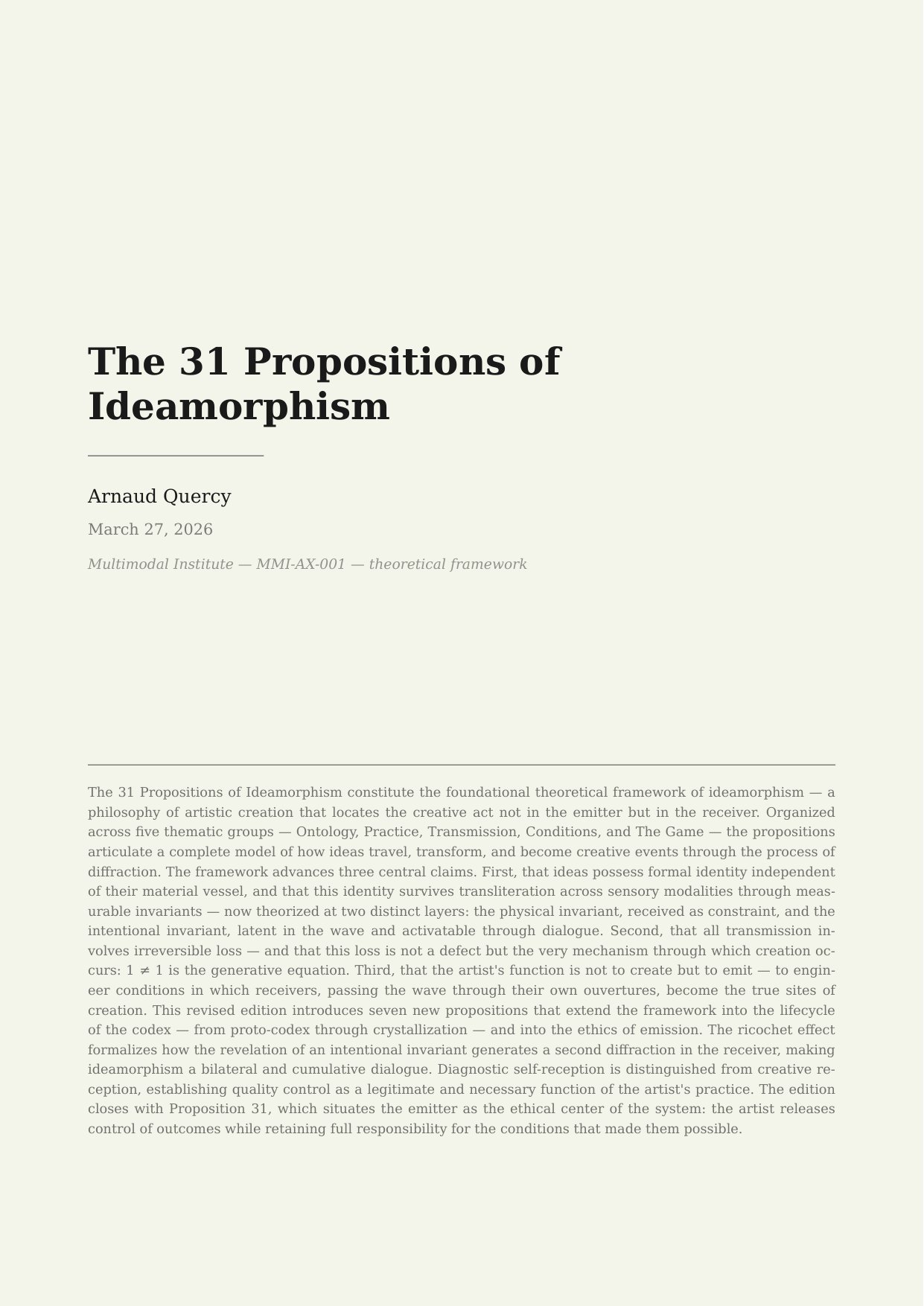
The 31 Propositions of Ideamorphism
PUB-PAP0002
- Download PDF (English)https://publishing.artquamanima.com/en/papers/2026/03/the-31-propositions-of-ideamorphism-29yr.pdf
- Download PDF (French)https://publishing.artquamanima.com/fr/papers/2026/03/les-31-propositions-de-lideamorphisme-29yr.pdf
- Read Onlinehttps://ideamorphism.org/en/publications/2026/03/the-31-propositions-of-ideamorphism.html
Bibliographic Record
| Title | The 31 Propositions of Ideamorphism |
|---|---|
| Author | Arnaud Quercy |
| Series | Theory |
| ISSN | (pending) |
| Fascicule | PAP-THE000002 |
| Asset code | PUB-PAP0002 |
| DOI | (pending) |
| Publisher (DBA) | Art Quam Anima Publishing New York |
| Legal entity | AQA Publishing LLC — Albany, NY |
| Imprint country | United States |
| Publication date | March 2026 |
| Last updated | 2026-09-15 |
| Language | English |
| Format | PDF · 7 p. |
| License | CC BY 4.0 |
| Persistent URI | https://publishing.artquamanima.com/en/papers/2026/03/the-31-propositions-of-ideamorphism-29yr.pdf |
Abstract
The 31 Propositions of Ideamorphism constitute the foundational theoretical framework of ideamorphism — a philosophy of artistic creation that locates the creative act not in the emitter but in the receiver. Organized across five thematic groups — Ontology, Practice, Transmission, Conditions, and The Game — the propositions articulate a complete model of how ideas travel, transform, and become creative events through the process of diffraction.
The framework advances three central claims. First, that ideas possess formal identity independent of their material vessel, and that this identity survives transliteration across sensory modalities through measurable invariants — now theorized at two distinct layers: the physical invariant, received as constraint, and the intentional invariant, latent in the wave and activatable through dialogue. Second, that all transmission involves irreversible loss — and that this loss is not a defect but the very mechanism through which creation occurs: 1 ≠ 1 is the generative equation. Third, that the artist's function is not to create but to emit — to engineer conditions in which receivers, passing the wave through their own ouvertures, become the true sites of creation.
This revised edition introduces seven new propositions that extend the framework into the lifecycle of the codex — from proto-codex through crystallization — and into the ethics of emission. The ricochet effect formalizes how the revelation of an intentional invariant generates a second diffraction in the receiver, making ideamorphism a bilateral and cumulative dialogue. Diagnostic self-reception is distinguished from creative reception, establishing quality control as a legitimate and necessary function of the artist's practice. The edition closes with Proposition 31, which situates the emitter as the ethical center of the system: the artist releases control of outcomes while retaining full responsibility for the conditions that made them possible.
Publication Details
- Author: Arnaud Quercy
- Date: March 2026
- Publisher: Art Quam Anima Publishing New York
- Genre: Institutio
- Reference Code: PUB-PAP0002
- Series: Ideamorphic Studies
- Pages: 7
- Languages: English / French
References
[1] Quercy, A. (2026). Manifesto Ideamorphiste. Zenodo. https://doi.org/10.5281/zenodo.19953318 PDF: https://publishing.artquamanima.com/en/papers/2026/02/manifesto-ideamorphiste-1ubj.pdf
Cite this work
Quercy, A. (2026). The 31 Propositions of Ideamorphism. Art Quam Anima Publishing New York. https://doi.org/10.5281/zenodo.19955299
- DOI (this version)
- 10.5281/zenodo.22773836
- DOI (all versions)
- 10.5281/zenodo.19955299
- Deposited
- Version 2 · 2026-09-15
- License
- CC BY 4.0