The Prescribed and the Realized: A Measurement Device for a Chromatic Codex
PUB-PAP0004
- Download PDF (English)https://publishing.artquamanima.com/en/papers/2026/03/the-prescribed-and-the-realized-a-measurement-device-for-a-chromatic-codex-29z0.pdf
- Download PDF (French)https://publishing.artquamanima.com/fr/papers/2026/03/le-prescrit-et-le-realise-un-dispositif-de-mesure-pour-un-codex-chromatique-29z0.pdf
- Read Onlinehttps://ideamorphism.org/en/publications/2026/03/the-prescribed-and-the-realized-a-measurement-device-for-a-chromatic-codex.html
Bibliographic Record
| Title | The Prescribed and the Realized: A Measurement Device for a Chromatic Codex |
|---|---|
| Author | Arnaud Quercy |
| Series | Theory |
| ISSN | (pending) |
| Fascicule | PAP-THE000003 |
| Asset code | PUB-PAP0004 |
| DOI | (pending) |
| Publisher (DBA) | Art Quam Anima Publishing New York |
| Legal entity | AQA Publishing LLC — Albany, NY |
| Imprint country | United States |
| Publication date | March 2026 |
| Last updated | 2026-09-20 |
| Language | English |
| Format | PDF · 7 p. |
| License | CC BY 4.0 |
| Persistent URI | https://publishing.artquamanima.com/en/papers/2026/03/the-prescribed-and-the-realized-a-measurement-device-for-a-chromatic-codex-29z0.pdf |
Abstract
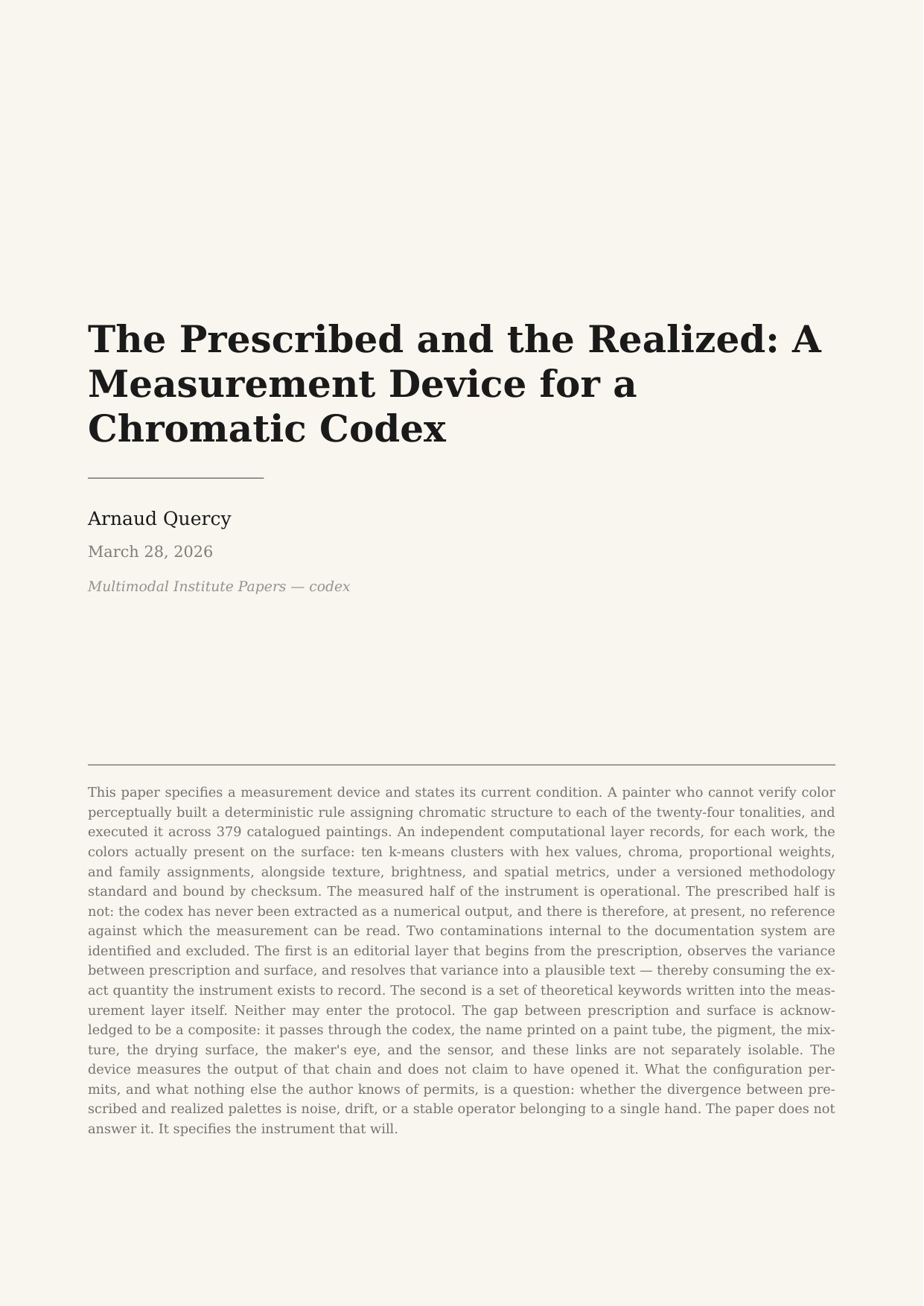
This paper specifies a measurement device and states its current condition.
A painter who cannot verify color perceptually built a deterministic rule assigning chromatic structure to each of the twenty-four tonalities, and executed it across 379 catalogued paintings. An independent computational layer records, for each work, the colors actually present on the surface: ten k-means clusters with hex values, chroma, proportional weights, and family assignments, alongside texture, brightness, and spatial metrics, under a versioned methodology standard and bound by checksum. The measured half of the instrument is operational. The prescribed half is not: the codex has never been extracted as a numerical output, and there is therefore, at present, no reference against which the measurement can be read.
Two contaminations internal to the documentation system are identified and excluded. The first is an editorial layer that begins from the prescription, observes the variance between prescription and surface, and resolves that variance into a plausible text — thereby consuming the exact quantity the instrument exists to record. The second is a set of theoretical keywords written into the measurement layer itself. Neither may enter the protocol.
The gap between prescription and surface is acknowledged to be a composite: it passes through the codex, the name printed on a paint tube, the pigment, the mixture, the drying surface, the maker's eye, and the sensor, and these links are not separately isolable. The device measures the output of that chain and does not claim to have opened it.
What the configuration permits, and what nothing else the author knows of permits, is a question: whether the divergence between prescribed and realized palettes is noise, drift, or a stable operator belonging to a single hand. The paper does not answer it. It specifies the instrument that will.
Publication Details
- Author: Arnaud Quercy
- Date: March 2026
- Publisher: Art Quam Anima Publishing New York
- Genre: Codex
- Reference Code: PUB-PAP0004
- Series: Ideamorphic Studies Papers
- Pages: 7
- Languages: English / French
References
- Folding a Recording onto a Fundamental: A Pitch Codex for Field Materialhttps://ideamorphism.org/en/publications/2026/08/folding-a-recording-onto-a-fundamental-a-pitch-codex-for-field-material-5e6k.html
https://publishing.artquamanima.com/en/papers/2026/08/folding-a-recording-onto-a-fundamental-a-pitch-codex-for-field-material-5e6l.pdf - Fixing a Grid on What Has No Pulse: A Rhythm Codex for Field Materialhttps://ideamorphism.org/en/publications/2026/08/fixing-a-grid-on-what-has-no-pulse-a-rhythm-codex-for-field-material-5e8l.html
https://publishing.artquamanima.com/en/papers/2026/08/fixing-a-grid-on-what-has-no-pulse-a-rhythm-codex-for-field-material-5e8m.pdf - Naming the Shape of a Loudness: A Form Codex for Field Materialhttps://ideamorphism.org/en/publications/2026/08/naming-the-shape-of-a-loudness-a-form-codex-for-field-material-5e8p.html
https://publishing.artquamanima.com/en/papers/2026/08/naming-the-shape-of-a-loudness-a-form-codex-for-field-material-5e8q.pdf