The Diffraction Equation: A Formal Foundation for Ideamorphism
PUB-PAP0003
- Download PDF (English)https://publishing.artquamanima.com/en/papers/2026/05/the-diffraction-equation-a-formal-foundation-for-ideamorphism-2di4.pdf
- Download PDF (French)https://publishing.artquamanima.com/fr/papers/2026/05/the-diffraction-equation-a-formal-foundation-for-ideamorphism-2di4.pdf
- Read Onlinehttps://multimodal.institute/en/publications/2026/05/the-diffraction-equation-a-formal-foundation-for-ideamorphism.html
Bibliographic Record
| Title | The Diffraction Equation: A Formal Foundation for Ideamorphism |
|---|---|
| Author | Arnaud Quercy |
| Series | Papers |
| ISSN | (pending) |
| Fascicule | PAP-GEN000005 |
| Asset code | PUB-PAP0003 |
| DOI | (pending) |
| Publisher (DBA) | Art Quam Anima Publishing New York |
| Legal entity | AQA Publishing LLC — Albany, NY |
| Imprint country | United States |
| Publication date | May 2026 |
| Last updated | 2026-05-18 |
| Language | English |
| Format | PDF · 15 p. |
| License | CC BY 4.0 |
| Persistent URI | https://publishing.artquamanima.com/en/papers/2026/05/the-diffraction-equation-a-formal-foundation-for-ideamorphism-2di4.pdf |
Abstract
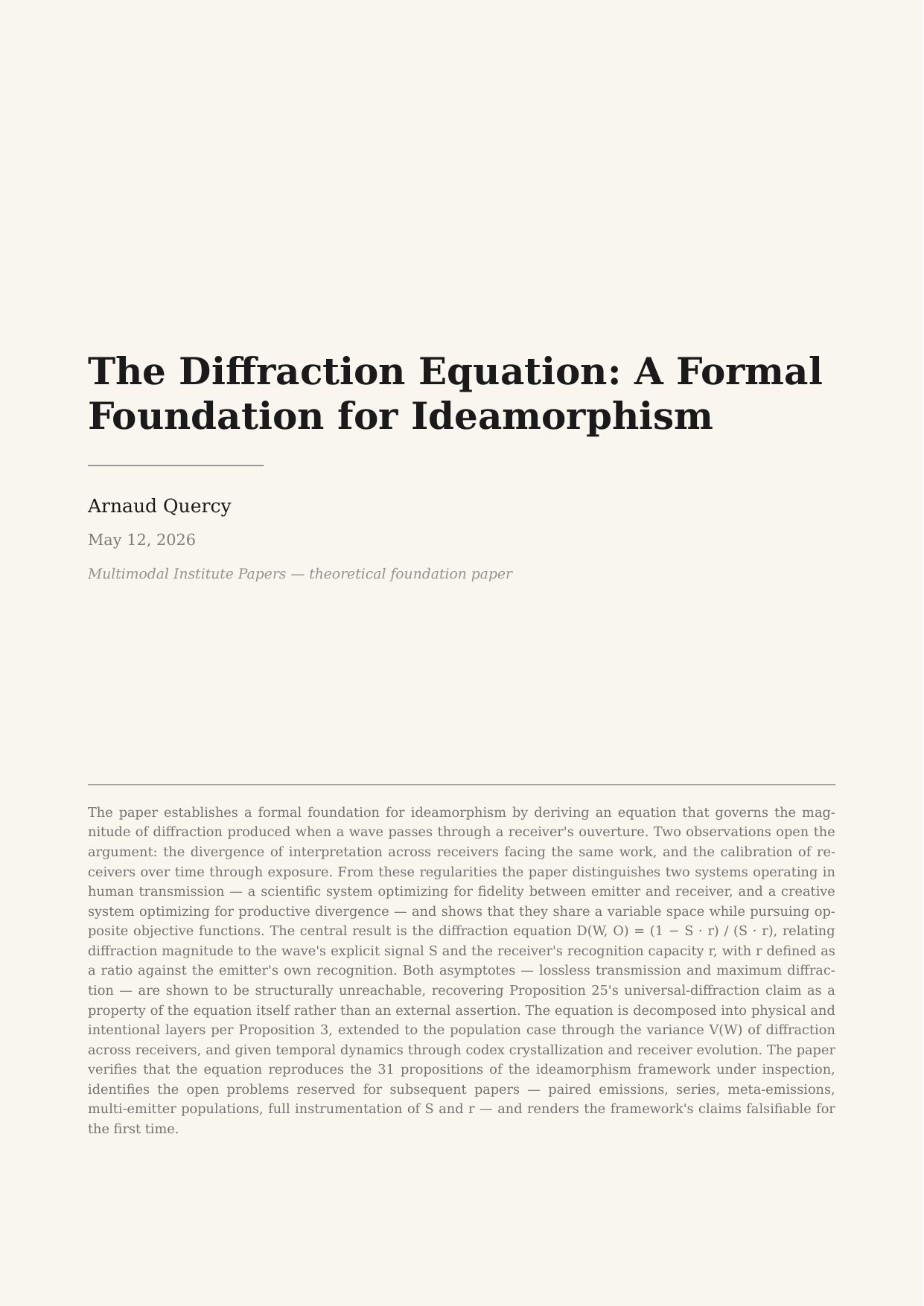
The paper establishes a formal foundation for ideamorphism by deriving an equation that governs the magnitude of diffraction produced when a wave passes through a receiver's ouverture. Two observations open the argument: the divergence of interpretation across receivers facing the same work, and the calibration of receivers over time through exposure. From these regularities the paper distinguishes two systems operating in human transmission — a scientific system optimizing for fidelity between emitter and receiver, and a creative system optimizing for productive divergence — and shows that they share a variable space while pursuing opposite objective functions.
The central result is the diffraction equation D(W, O) = (1 − S · r) / (S · r), relating diffraction magnitude to the wave's explicit signal S and the receiver's recognition capacity r, with r defined as a ratio against the emitter's own recognition. Both asymptotes — lossless transmission and maximum diffraction — are shown to be structurally unreachable, recovering Proposition 25's universal-diffraction claim as a property of the equation itself rather than an external assertion. The equation is decomposed into physical and intentional layers per Proposition 3, extended to the population case through the variance V(W) of diffraction across receivers, and given temporal dynamics through codex crystallization and receiver evolution.
The paper verifies that the equation reproduces the 31 propositions of the ideamorphism framework under inspection, identifies the open problems reserved for subsequent papers — paired emissions, series, meta-emissions, multi-emitter populations, full instrumentation of S and r — and renders the framework's claims falsifiable for the first time.
Publication Details
- Author: Arnaud Quercy
- Date: May 2026
- Publisher: Art Quam Anima Publishing New York
- Genre: Theoretical foundation paper
- Reference Code: PUB-PAP0003
- Series: Multimodal Institute Papers
- Pages: 15
- Languages: English / French
References
References
- Quercy, A. (2026). The Infrastructure Is the Artwork: MMI as Meta-Emission. https://multimodal.institute/en/publications/2026/03/the-infrastructure-is-the-artwork-mmi-as-meta-emission.html
- Quercy, A. (2026). The Infrastructure Is the Artwork: MMI as Meta-Emission - PDF. https://publishing.artquamanima.com/en/papers/2026/03/the-infrastructure-is-the-artwork-mmi-as-meta-emission-29z0.pdf