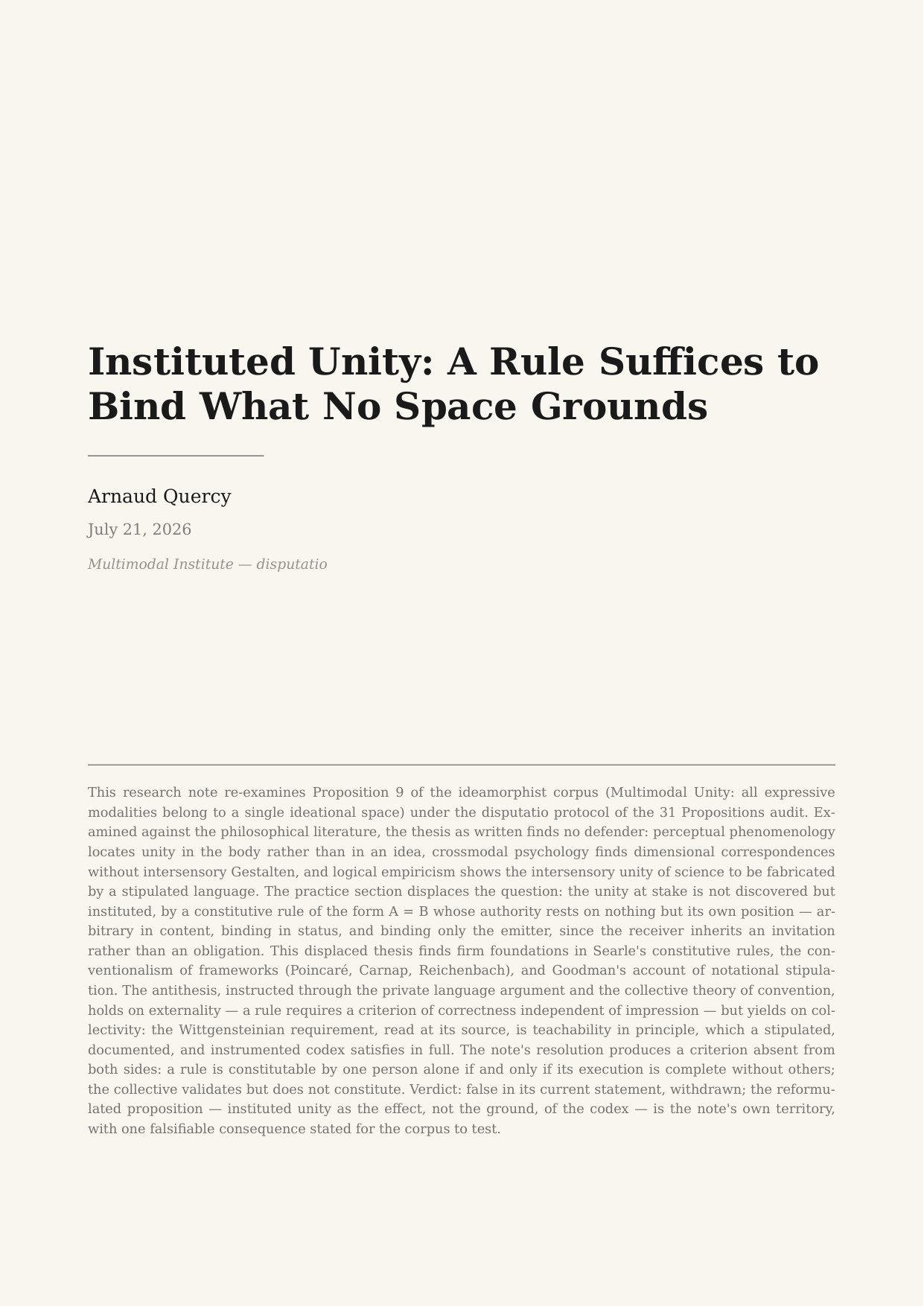
Instituted Unity: A Rule Suffices to Bind What No Space Grounds
PUB-PAP0005
- Download PDF (English)https://publishing.artquamanima.com/en/papers/2026/07/instituted-unity-a-rule-suffices-to-bind-what-no-space-grounds-5bkw.pdf
- Download PDF (French)https://publishing.artquamanima.com/fr/papers/2026/07/unite-instituee-une-regle-suffit-a-lier-ce-quaucun-espace-ne-fonde-5bkw.pdf
- Read Onlinehttps://ideamorphism.org/en/publications/2026/07/instituted-unity-a-rule-suffices-to-bind-what-no-space-grounds-5bkx.html
Bibliographic Record
| Title | Instituted Unity: A Rule Suffices to Bind What No Space Grounds |
|---|---|
| Author | Arnaud Quercy |
| Series | Theory |
| ISSN | (pending) |
| Fascicule | PAP-THE000005 |
| Asset code | PUB-PAP0005 |
| DOI | (pending) |
| Publisher (DBA) | Art Quam Anima Publishing New York |
| Legal entity | AQA Publishing LLC — Albany, NY |
| Imprint country | United States |
| Publication date | July 2026 |
| Last updated | 2026-09-15 |
| Language | English |
| Format | PDF · 8 p. |
| License | CC BY 4.0 |
| Persistent URI | https://publishing.artquamanima.com/en/papers/2026/07/instituted-unity-a-rule-suffices-to-bind-what-no-space-grounds-5bkw.pdf |
Abstract
This research note re-examines Proposition 9 of the ideamorphist corpus (Multimodal Unity: all expressive modalities belong to a single ideational space) under the disputatio protocol of the 31 Propositions audit. Examined against the philosophical literature, the thesis as written finds no defender: perceptual phenomenology locates unity in the body rather than in an idea, crossmodal psychology finds dimensional correspondences without intersensory Gestalten, and logical empiricism shows the intersensory unity of science to be fabricated by a stipulated language. The practice section displaces the question: the unity at stake is not discovered but instituted, by a constitutive rule of the form A = B whose authority rests on nothing but its own position — arbitrary in content, binding in status, and binding only the emitter, since the receiver inherits an invitation rather than an obligation. This displaced thesis finds firm foundations in Searle's constitutive rules, the conventionalism of frameworks (Poincaré, Carnap, Reichenbach), and Goodman's account of notational stipulation. The antithesis, instructed through the private language argument and the collective theory of convention, holds on externality — a rule requires a criterion of correctness independent of impression — but yields on collectivity: the Wittgensteinian requirement, read at its source, is teachability in principle, which a stipulated, documented, and instrumented codex satisfies in full. The note's resolution produces a criterion absent from both sides: a rule is constitutable by one person alone if and only if its execution is complete without others; the collective validates but does not constitute. Verdict: false in its current statement, withdrawn; the reformulated proposition — instituted unity as the effect, not the ground, of the codex — is the note's own territory, with one falsifiable consequence stated for the corpus to test.
Publication Details
- Author: Arnaud Quercy
- Date: July 2026
- Publisher: Art Quam Anima Publishing New York
- Genre: Disputatio
- Reference Code: PUB-PAP0005
- Series: Ideamorphic Studies
- Pages: 8
- Languages: English / French
Cite this work
Quercy, A. (2026). Instituted Unity: A Rule Suffices to Bind What No Space Grounds. Zenodo. https://doi.org/10.5281/zenodo.22770991
- DOI (this version)
- 10.5281/zenodo.22770991
- DOI (all versions)
- 10.5281/zenodo.22769643
- Deposited
- Version 2 · 2026-09-15
- License
- CC BY 4.0