Fixing a Grid on What Has No Pulse: A Rhythm Codex for Field Material
PUB-PAP0011
- Download PDF (English)https://publishing.artquamanima.com/en/papers/2026/08/fixing-a-grid-on-what-has-no-pulse-a-rhythm-codex-for-field-material-5e8m.pdf
- Download PDF (French)https://publishing.artquamanima.com/fr/papers/2026/08/poser-une-grille-sur-ce-qui-na-pas-de-pouls-un-codex-de-rythme-pour-materiau-de-terrain-5e8m.pdf
- Read Onlinehttps://ideamorphism.org/en/publications/2026/08/fixing-a-grid-on-what-has-no-pulse-a-rhythm-codex-for-field-material-5e8l.html
Bibliographic Record
| Title | Fixing a Grid on What Has No Pulse: A Rhythm Codex for Field Material |
|---|---|
| Author | Arnaud Quercy |
| Series | Theory |
| ISSN | (pending) |
| Fascicule | PAP-THE000011 |
| Asset code | PUB-PAP0011 |
| DOI | (pending) |
| Publisher (DBA) | Art Quam Anima Publishing New York |
| Legal entity | AQA Publishing LLC — Albany, NY |
| Imprint country | United States |
| Publication date | August 2026 |
| Last updated | 2026-09-15 |
| Language | English |
| Format | PDF · 9 p. |
| License | CC BY 4.0 |
| Persistent URI | https://publishing.artquamanima.com/en/papers/2026/08/fixing-a-grid-on-what-has-no-pulse-a-rhythm-codex-for-field-material-5e8m.pdf |
Abstract
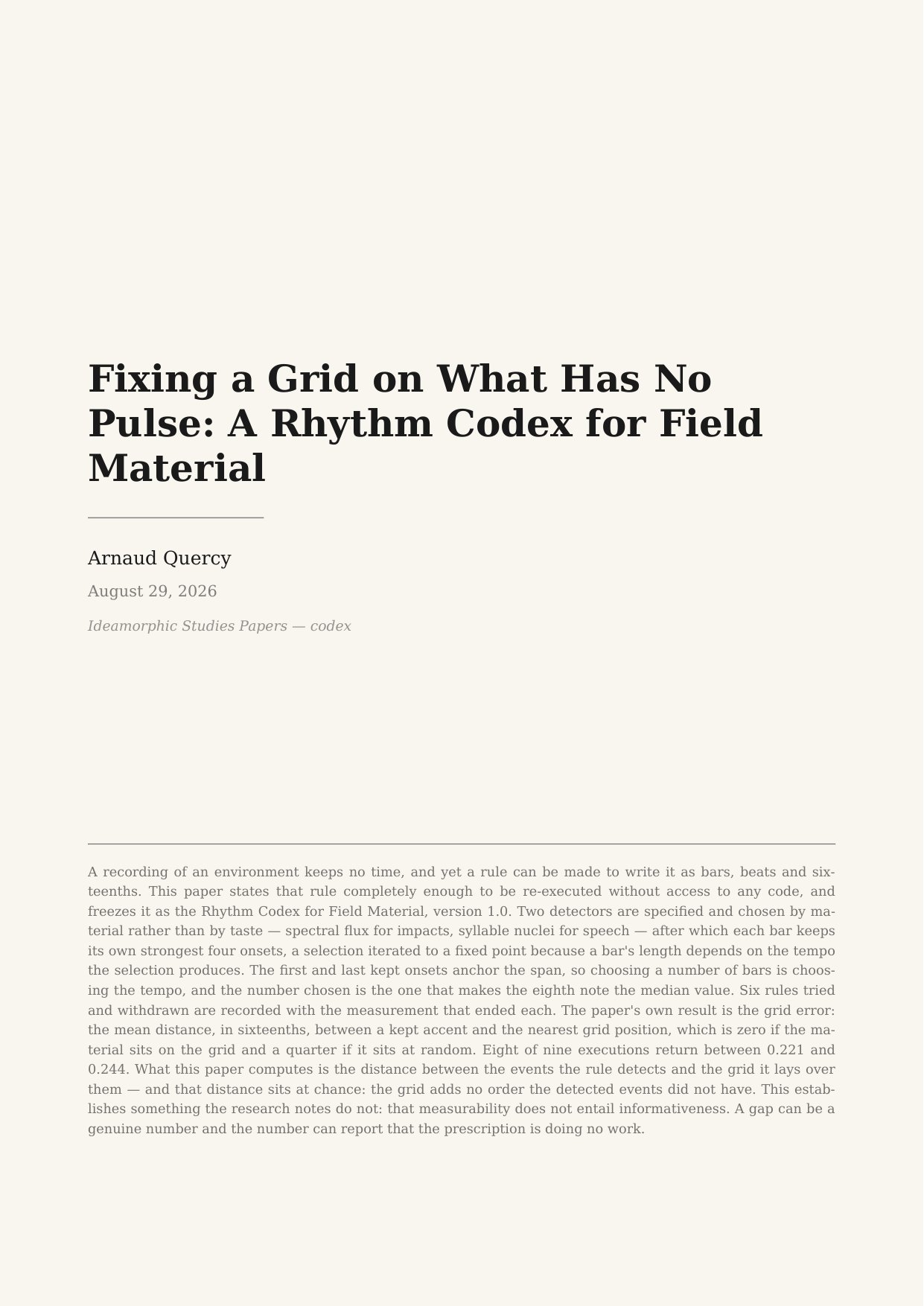
A recording of an environment keeps no time, and yet a rule can be made to write it as bars, beats and sixteenths. This paper states that rule completely enough to be re-executed without access to any code, and freezes it as the Rhythm Codex for Field Material, version 1.0. Two detectors are specified and chosen by material rather than by taste — spectral flux for impacts, syllable nuclei for speech — after which each bar keeps its own strongest four onsets, a selection iterated to a fixed point because a bar's length depends on the tempo the selection produces. The first and last kept onsets anchor the span, so choosing a number of bars is choosing the tempo, and the number chosen is the one that makes the eighth note the median value. Six rules tried and withdrawn are recorded with the measurement that ended each. The paper's own result is the grid error: the mean distance, in sixteenths, between a kept accent and the nearest grid position, which is zero if the material sits on the grid and a quarter if it sits at random. Eight of nine executions return between 0.221 and 0.244. What this paper computes is the distance between the events the rule detects and the grid it lays over them — and that distance sits at chance: the grid adds no order the detected events did not have. This establishes something the research notes do not: that measurability does not entail informativeness. A gap can be a genuine number and the number can report that the prescription is doing no work.
Publication Details
- Author: Arnaud Quercy
- Date: August 2026
- Publisher: Art Quam Anima Publishing New York
- Genre: Codex
- Reference Code: PUB-PAP0011
- Series: Ideamorphic Studies Papers
- Pages: 9
- Languages: English / French
References
- Naming the Shape of a Loudness: A Form Codex for Field Materialhttps://ideamorphism.org/en/publications/2026/08/naming-the-shape-of-a-loudness-a-form-codex-for-field-material-5e8p.html
https://publishing.artquamanima.com/en/papers/2026/08/naming-the-shape-of-a-loudness-a-form-codex-for-field-material-5e8q.pdf
Cite this work
Quercy, A. (2026). Fixing a Grid on What Has No Pulse: A Rhythm Codex for Field Material. Art Quam Anima Publishing New York. https://doi.org/10.5281/zenodo.22775346
- DOI (this version)
- 10.5281/zenodo.22775347
- DOI (all versions)
- 10.5281/zenodo.22775346
- Deposited
- Version 1.0 · 2026-09-15
- License
- CC BY 4.0