What Precedes Execution: Direction, Not Figure
PUB-PAP0008
- Download PDF (English)https://publishing.artquamanima.com/en/papers/2026/08/what-precedes-execution-direction-not-figure-5deh.pdf
- Download PDF (French)https://publishing.artquamanima.com/fr/papers/2026/08/ce-qui-precede-lexecution-direction-non-figure-5deh.pdf
- Read Onlinehttps://ideamorphism.org/en/publications/2026/08/what-precedes-execution-direction-not-figure-5deg.html
Bibliographic Record
| Title | What Precedes Execution: Direction, Not Figure |
|---|---|
| Author | Arnaud Quercy |
| Series | Theory |
| ISSN | (pending) |
| Fascicule | PAP-THE000008 |
| Asset code | PUB-PAP0008 |
| DOI | (pending) |
| Publisher (DBA) | Art Quam Anima Publishing New York |
| Legal entity | AQA Publishing LLC — Albany, NY |
| Imprint country | United States |
| Publication date | August 2026 |
| Last updated | 2026-08-17 |
| Language | English |
| Format | PDF · 13 p. |
| License | CC BY-NC-SA 4.0 |
| Persistent URI | https://publishing.artquamanima.com/en/papers/2026/08/what-precedes-execution-direction-not-figure-5deh.pdf |
Abstract
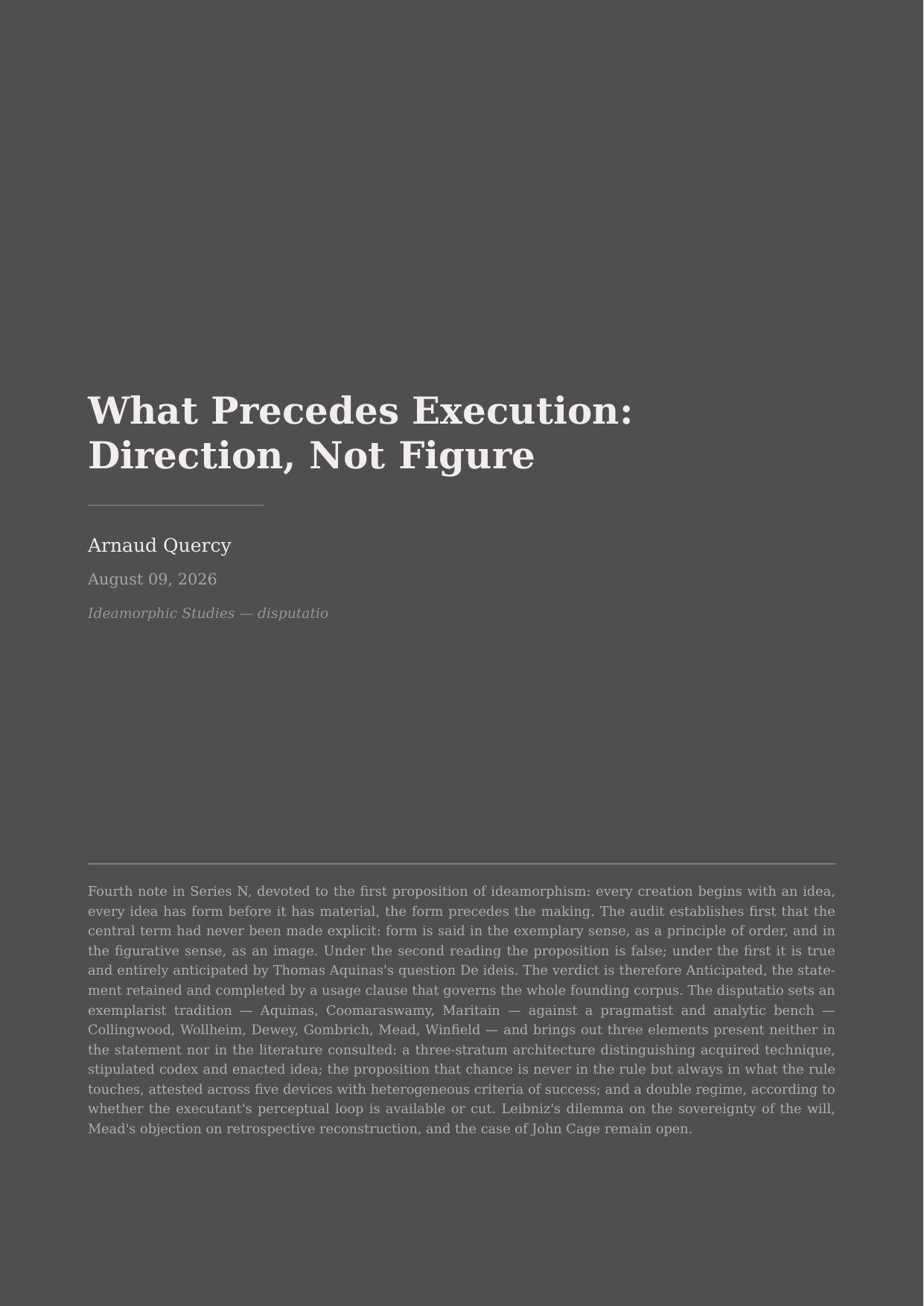
Fourth note in Series N, devoted to the first proposition of ideamorphism: every creation begins with an idea, every idea has form before it has material, the form precedes the making. The audit establishes first that the central term had never been made explicit: form is said in the exemplary sense, as a principle of order, and in the figurative sense, as an image. Under the second reading the proposition is false; under the first it is true and entirely anticipated by Thomas Aquinas's question De ideis. The verdict is therefore Anticipated, the statement retained and completed by a usage clause that governs the whole founding corpus. The disputatio sets an exemplarist tradition — Aquinas, Coomaraswamy, Maritain — against a pragmatist and analytic bench — Collingwood, Wollheim, Dewey, Gombrich, Mead, Winfield — and brings out three elements present neither in the statement nor in the literature consulted: a three-stratum architecture distinguishing acquired technique, stipulated codex and enacted idea; the proposition that chance is never in the rule but always in what the rule touches, attested across five devices with heterogeneous criteria of success; and a double regime, according to whether the executant's perceptual loop is available or cut. Leibniz's dilemma on the sovereignty of the will, Mead's objection on retrospective reconstruction, and the case of John Cage remain open.
Publication Details
- Author: Arnaud Quercy
- Date: August 2026
- Publisher: Art Quam Anima Publishing New York
- Genre: Disputatio
- Reference Code: PUB-PAP0008
- Series: Ideamorphic Studies
- Pages: 13
- Languages: English / French