Encounters with Umberto Eco
PUB-PAP0003
- Download PDF (English)https://publishing.artquamanima.com/en/papers/2026/04/encounters-with-umberto-eco-2cr7.pdf
- Download PDF (French)https://publishing.artquamanima.com/fr/papers/2026/04/rencontres-avec-umberto-eco-2cr7.pdf
- Read Onlinehttps://ideamorphism.org/en/publications/2026/04/encounters-with-umberto-eco.html
Bibliographic Record
| Title | Encounters with Umberto Eco |
|---|---|
| Author | Arnaud Quercy |
| Series | Theory |
| ISSN | (pending) |
| Fascicule | PAP-THE000004 |
| Asset code | PUB-PAP0003 |
| DOI | (pending) |
| Publisher (DBA) | Art Quam Anima Publishing New York |
| Legal entity | AQA Publishing LLC — Albany, NY |
| Imprint country | United States |
| Publication date | April 2026 |
| Last updated | 2026-08-02 |
| Language | English |
| Format | PDF · 7 p. |
| License | CC BY 4.0 |
| Persistent URI | https://publishing.artquamanima.com/en/papers/2026/04/encounters-with-umberto-eco-2cr7.pdf |
Abstract
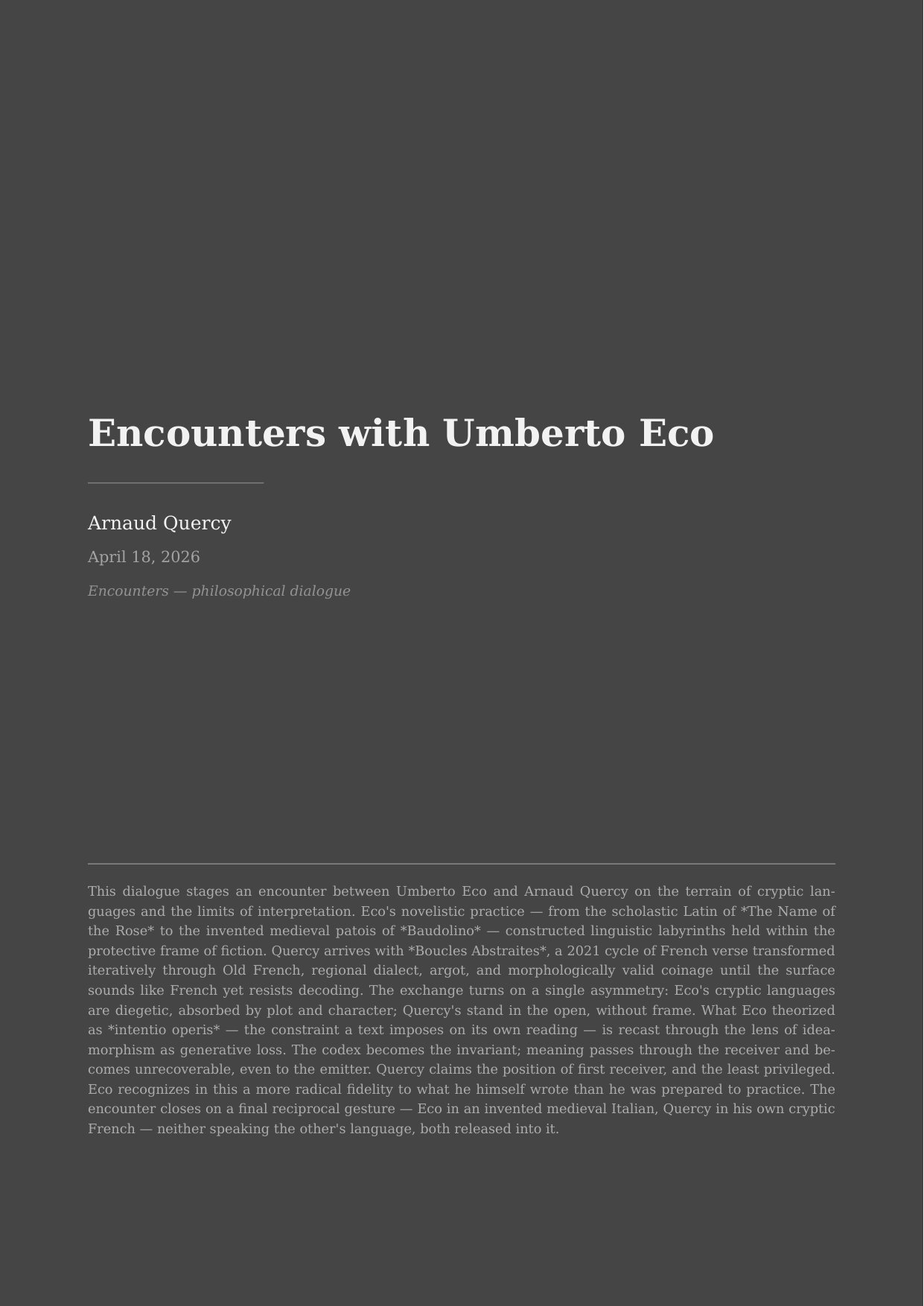
This dialogue stages an encounter between Umberto Eco and Arnaud Quercy on the terrain of cryptic languages, and it does not end where it was intended to end.
Quercy arrives with *Boucles Abstraites*, a 2021 cycle of French verse transformed iteratively through Old French, regional dialect, argot, and morphologically valid coinage until the surface sounds like French yet resists decoding. He arrives, too, with a framework in which the creative act is located not in the emitter but in the receiver, and in which a single work produces as many creations as it has readings. Eco recognizes the procedure. He also recognizes the framework, because he wrote it: *Opera aperta*, 1962, in which the work of art is a form to be completed by its receiver, and each completion is a distinct object, none of them the work. And Eco declines the credit in turn: Roman Ingarden had described the schematic structure of the artwork and its places of indeterminacy in 1931, thirty years before him, in Polish, in a book almost no one read.
What the encounter yields is not a theory but a subtraction. The claim Quercy believed he had arrived at through practice was already established, twice, and better. What survives the subtraction is narrower and, Eco argues, more valuable: not a doctrine of reception, but a device. Ingarden and Eco theorized the reader. Quercy built a rule that renders its own author a stranger to his own text, and leaves the evidence on the page. The dialogue closes on a final reciprocal gesture — Eco in an invented medieval Italian, Quercy in his own cryptic French — neither speaking the other's language, both released into it.
Publication Details
- Author: Arnaud Quercy
- Date: April 2026
- Publisher: Art Quam Anima Publishing New York
- Genre: Dialogus
- Reference Code: PUB-PAP0003
- Series: Encounters
- Pages: 7
- Languages: English / French